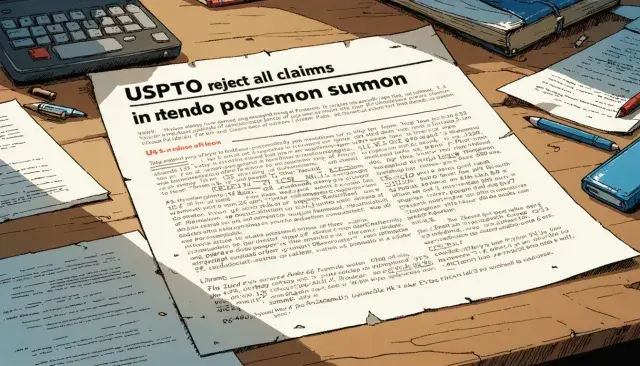
The United States Patent and Trademark Office has rejected every claim in Nintendo's US Patent No. 12,433,397, which covered summoning a sub-character to battle in gameplay. This non-final ruling, issued in April 2026, rests on prior art from earlier patent applications, undermining a core element of Nintendo's intellectual property enforcement. The decision highlights vulnerabilities in broad patents on longstanding game mechanics and reassures developers wary of litigation over foundational features.
The Patent's Scope and Rejection Grounds
Granted in 2025 to Nintendo and The Pokémon Company, the patent targeted the mechanic of summoning a creature, such as a Pokémon, to fight within a specific mode. This described the familiar loop of releasing a creature from a container for battle and capture, present in Pokémon titles since the 1990s. The USPTO examiner dismissed all 26 claims: 18 as obvious combinations of two prior art references, and 8 as obvious from three references.
Prior Art from Nintendo's Own Filings
Prior art came exclusively from published US patent applications predating Nintendo's filing, including two from Nintendo itself, one from Konami, and one from Bandai Namco. IP experts had long argued the claims lacked novelty, with the mechanic appearing in games like Persona, Digimon, and potentially others such as Elden Ring. The USPTO Director John A. Squires ordered this reexamination in November 2025 on his own initiative—the first since 2012—without needing a third-party request.
Links to Nintendo's Palworld Lawsuit
This patent differs from the three Japanese patents Nintendo cited in its 2024 lawsuit against Pocketpair, developer of Palworld, which focus on creature capture, release, and riding. Pocketpair altered Palworld mechanics under pressure, removing summons via ball-like spheres. Though not directly involved, the US rejection weakens the precedent for aggressive enforcement of broad gameplay patents, amid a lull in the Japanese case since late 2025.
Implications for Game Developers
Indie studios view the ruling as validation against fears of large firms patenting genre staples like monster-taming or turn-based combat, roots of which predate Pokémon. Nintendo retains other US Pokémon patents, but this exposes risks in expansive claims. The company now faces a two-month window, extendable, to amend claims or rebut the rejection, with appeal options to the Federal Circuit if needed.